Fall Arrest Injuries & How to Avoid Them
Fall arrest injuries are injuries that can happen when a fall arrest system stops a worker from hitting the ground, but exposes them to other hazards such as sudden stopping forces and the risk of suspension trauma.
A properly-planned fall arrest system can save a worker's life. If someone falls from a roof edge, MEWP or other elevated spot, their fall arrest harness and should keep them from hitting the ground.
However, stopping the fall is only part of the job. A fall arrest system must also reduce the risk of injury during and after the arrest. If the wrong equipment is used, if the harness does not fit correctly, or if no rescue plan is in place, the worker may still suffer serious harm.
How do fall arrest injuries happen?
When you're falling through the air, you're carrying a lot of energy. If your fall is suddenly stopped, that energy has to go somewhere – and the resulting force can be very dangerous.
A good fall arrest system should absorb this force with minimal harm to your person, but poor planning can leave you exposed to avoidable injury.
Common causes of fall arrest injuries include:
- Using equipment that is not suitable for the task
- Using a harness that's the wrong size or badly adjusted
- Connecting to an unsuitable anchor point
- Not allowing enough fall clearance below the worker
- Allowing the worker to swing into a wall, beam, column or other obstruction
- Leaving the worker suspended for too long after the fall has been arrested
The safest fall arrest system is one that has been planned around the person, the task, the anchor point, the surrounding structure and the rescue arrangements.
Sudden stopping forces
One of the main risks associated with fall arrest is the force created when the fall is brought to a stop. If the arrest is too abrupt, the worker may suffer bodily trauma, including injuries to the ribs, back, shoulders, neck and/or internal organs.
This is why it's important to use appropriate energy-absorbing equipment. Shock absorbing lanyards are designed to help reduce the force transferred to the worker during a fall arrest. They are not the right choice for every situation, but where a lanyard is being used to arrest a fall, shock absorption is usually a key part of the system.
Fall arrest equipment should always be selected by someone competent who understands the task, the available fall distance and the limitations of each product. A lanyard that is too long, too short or not designed for fall arrest applications can put the user at serious risk.
Suspension trauma
Suspension trauma (sometimes called harness hang syndrome, or HHS for short) is another serious risk. This can happen when a worker is left hanging in a harness after their fall has been stopped.
Being suspended upright and unable to move around freely makes it difficult for blood to reach your brain. This can lead to loss of consciousness and potentially life-threatening complications if you're not rescued quickly.
This is why every fall arrest system must be backed up with a robust rescue plan. It is not enough to assume that the emergency services will be able to arrive and retrieve the worker in time. Before any work at height begins, there should be a clear, practised plan for rescuing a suspended worker promptly and safely.
Poor harness fit
A safety harness must fit the user correctly. If the harness is too loose, the worker may slip partly or completely out of it during a fall. If it is too tight or badly adjusted, it may place dangerous pressure on the body when the fall is arrested.
Chest straps, leg loops and shoulder straps all need to sit correctly. A poorly-positioned chest strap may jerk upwards when a fall is stopped, causing discomfort or injury around the chest, throat or neck. Loose leg straps can also cause severe injury if the harness suddenly takes the worker's weight.
To minimise the risk, take accurate measurements before choosing a harness and make sure the harness is properly adjusted before use. Workers should also be trained to inspect and fit their own equipment correctly, because even the right harness can become unsafe if worn incorrectly.
Impact during the fall
A fall arrest system may stop the worker from hitting the ground, but that does not automatically mean they will avoid impact altogether.
Before work begins, think carefully about what the worker might strike during a fall. Nearby beams, scaffold tubes, machinery, roof projections, walls and other structures can all cause injury if the worker drops onto them or swings into them.
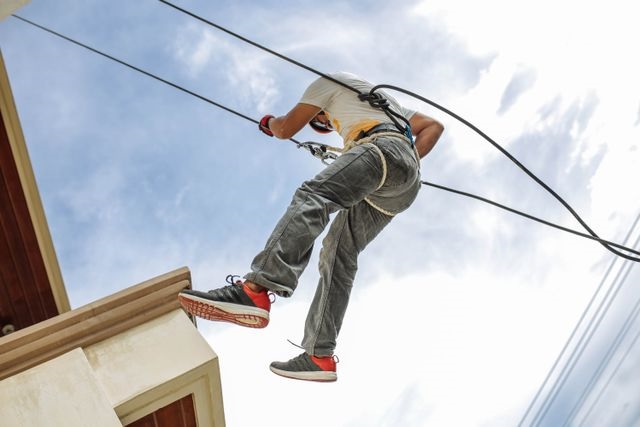
This is especially important when the anchor point is not directly above the worker. A poorly-positioned anchor can create a swing fall, where the worker arcs sideways after falling. In some situations, this can be just as dangerous as falling straight down.
How to minimise the risk of fall arrest injuries
The best way to reduce the risk of fall arrest injuries is to carefully plan out the whole system before work begins. This plan should account for the worker(s), the fall arrest equipment, the anchor point, the surrounding environment and the rescue procedure.
Before using any form of fall arrest equipment, ask:
- Is the equipment suitable for this specific task?
- Does this product fit the worker correctly?
- Is each piece of equipment suitable for fall arrest situations and compatible with the rest of the system?
- Is there enough fall clearance below the worker?
- Could the worker hit anything on their way down?
- Is there a clear rescue plan in place to ensure workers aren't left suspended?
Every piece of fall arrest equipment should also be thoroughly inspected before use. Webbing, stitching, buckles, connectors and anchor points should all be checked for damage, wear, contamination or anything else that could affect their performance.
Remember: fall prevention is better than fall arrest
Fall arrest systems are designed to protect workers after a fall has already happened. Where possible, it is always better to prevent the fall from happening in the first place.
Before choosing a fall arrest system, consider whether the work can be done from ground level. If work at height cannot be avoided, ask whether collective protection measures (such as guardrails or edge protection) can be used. If that is not practical, a fall restraint system may be a better option than fall arrest.
Fall restraint equipment is designed to stop the worker from reaching a hazardous area. For example, a restraint lanyard may prevent a worker from getting close enough to an unprotected roof edge to fall over it. This approach removes the need to arrest a fall because the fall should never occur.
Fall arrest gear still has an important place in height safety, but it should not be treated as the first or only option. Your aim should always be to choose the safest and most practical fall protection method for each job, then get the appropriate equipment in place.
Shop Fall Protection Equipment
Photo from pexels.com